Back to all guides
Logic & Deduction7 min read
Deductive Logic Demystified: Step-by-Step Problem Solving Strategies
How to approach constraint satisfaction, pathfinding, and non-linear pattern recognition like a grandmaster.
Daily Gaming Zone Strategy Desk
Mathematical Puzzle Designers
Updated 2026-08-15
Key Insights at a Glance
- Always start your deductive analysis at the corners and edges where degrees of freedom are lowest.
- Use proof by contradiction to safely rule out invalid branching paths.
- In flooding and territory games, focus on maximizing border contact rather than immediate cell counts.
- Patience and systematic elimination consistently beat rapid, uncalculated clicking.
1. The Anatomy of a Pure Logic Puzzle
Pure logic puzzles—such as path connectors (Pipe Connect, Color Connect), territory flooders (Color Flood), and binary state grids (Eclipse)—operate on deterministic constraint satisfaction. Unlike word games that rely on vocabulary recall, logic games rely purely on universal rules and structural relationships.
Understanding the exact constraints of the board before making a single move is the hallmark of an experienced player. Ask yourself: What are the strict invariants? What cannot change?
2. The Edge & Corner Anchoring Principle
In any two-dimensional grid puzzle, corners and perimeter edges have the fewest degrees of freedom. An interior cell in a grid has four orthogonal neighbors; an edge cell has three; a corner cell has only two.
Because corners have 50% fewer connection options, they enforce immediate, non-negotiable moves. In Pipe Connect or Color Connect, always begin your solving path from the corners and perimeter, working inward toward the complex center.
Rule of Thumb: When a board feels overwhelming, start where options are most restricted—the corners and edges will dictate the core flow.
3. Proof by Contradiction (Reductio ad Absurdum)
When you face two competing hypotheses for a cell, mentally project the board two steps forward under Hypothesis A. If Hypothesis A leads to an illegal state (such as an isolated dead-end or two conflicting endpoints), then Hypothesis A is proven false.
Eliminating the impossible immediately leaves the true path. This disciplined reasoning prevents panic and allows you to methodically dismantle high-difficulty levels.
4. Color & Territory Management in Flooding Games
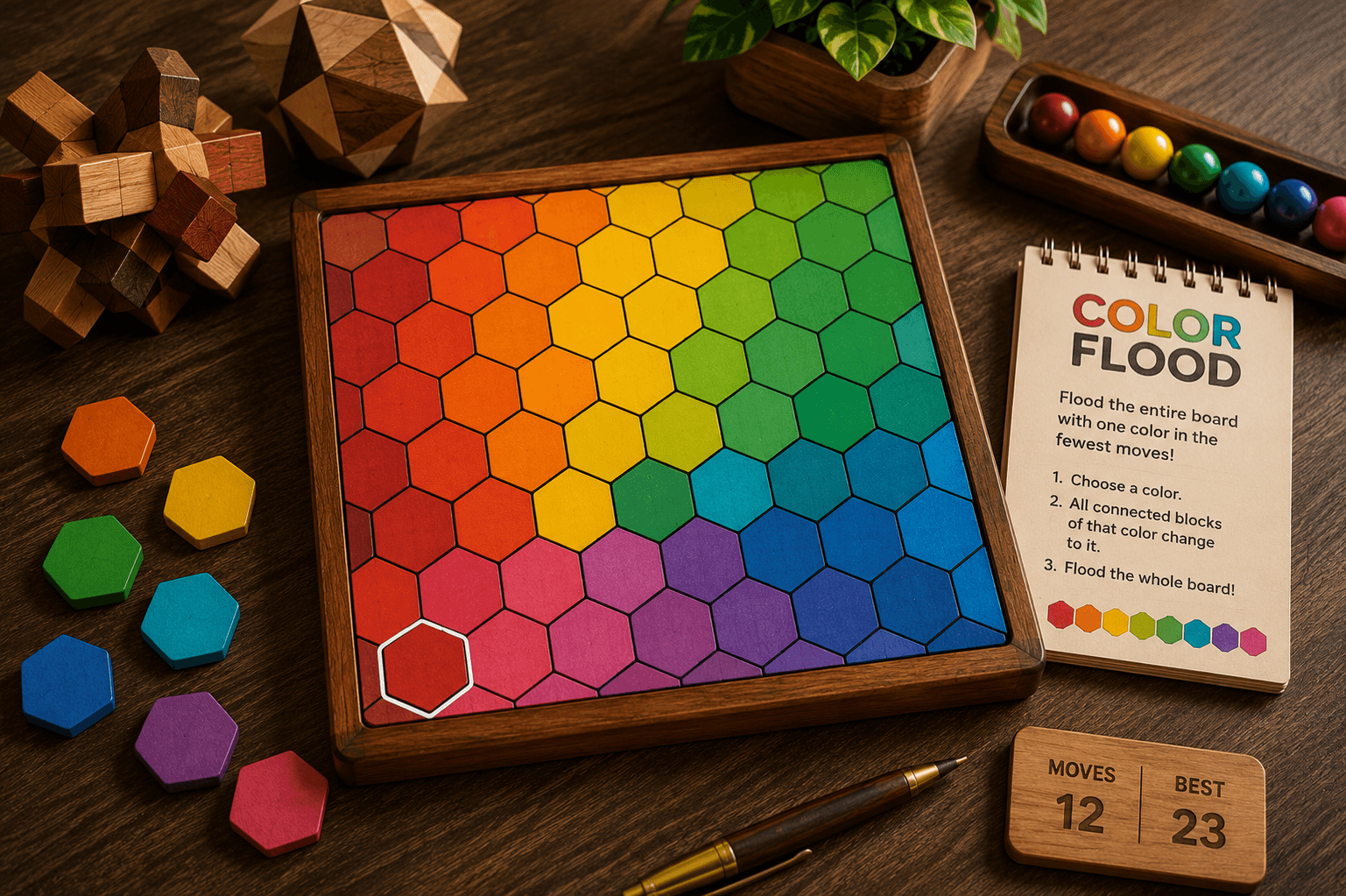
In games like Color Flood, novice players instinctively pick the color that matches adjacent single cells. Grandmasters, however, evaluate perimeter expansion potential.
On every move, identify which color choice will connect your active territory to the largest boundary surface of unexplored clusters. Maximizing boundary contact ensures you swallow the board in fewer total turns.